

Season 17, Episode 70: How Francis Halzen Turned 1 km3 of Ice into a Giant Neutrino Detector
Hey StarTalkians! Episode 70 of season 17 welcomed guest Professor Francis Halzen, who spoke with Neil and Chuck about his work with IceCube (not the rapper). You know it’s a good conversation when they casually mention that the guest won a Nobel Prize at the end of the show:
Neutrinos on Ice with Francis Halzen
(55:10)
Perhaps unsurprisingly, the Nobel was awarded for his work with the IceCube Observatory, but what exactly did he do?
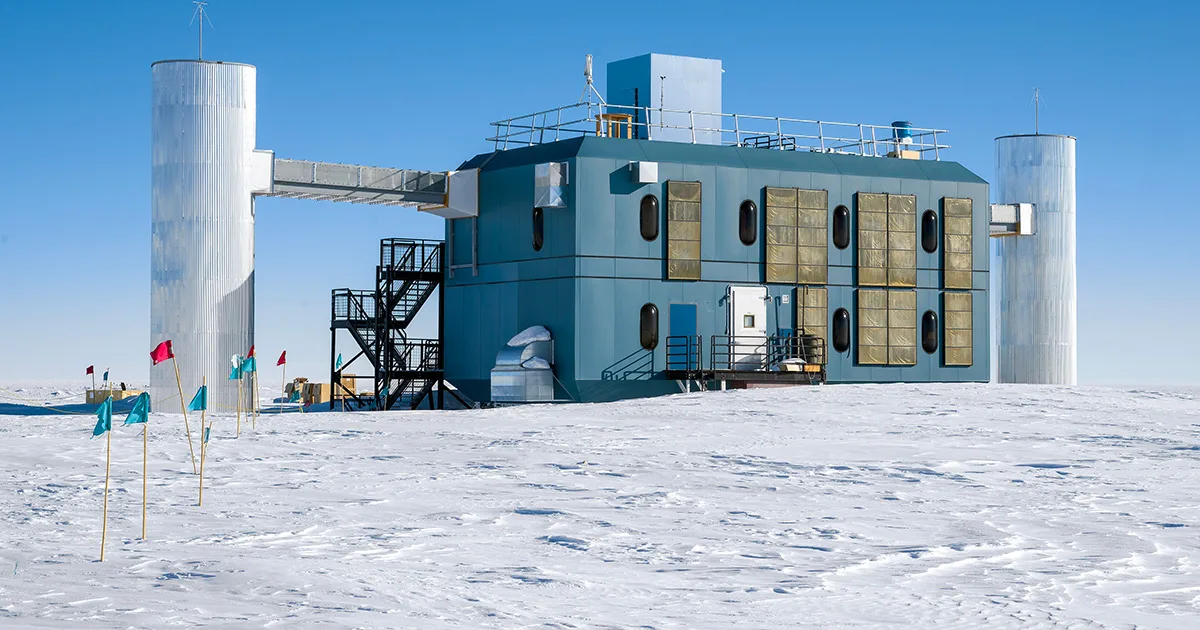
The Idea: Turning Antarctic Ice into a Neutrino Detector
Halzen’s idea is described in a 1988 paper he co-wrote which basically pitches his idea. The core concept – also discussed on the show – is Cherenkov radiation. This is analogous to a sonic boom from faster-than-sound travel: a particle moving through a medium continually produces radiation, but if it’s quicker than light in that medium, the radiation moves slower than it. This leads to a cone-shaped wake of overlapping light waves along its path.
Halzen realized that the huge amount of ice in Antartica could be used to help detect the Cherenkov radiation from the muons (basically heavy electrons) produced by neutrinos. He suggests detecting neutrinos coming up through the Earth, and points out that the detector can easily grow with so much ice around. He even pitched it as affordable relative to other ideas.
The Payoff: The First Cosmic Neutrino Detection
As Halzen points out, one big challenge is the “overwhelming background” of atmospheric neutrinos. You might detect a neutrino, but you need to be able to rule out these normal atmospheric interactions. One way that IceCube does this is by setting much stricter requirements for signals coming from above the detector, rather than through the Earth below.
A 2013 paper showed that the method likely works. The paper focuses on two detections of very high-energy neutrinos at IceCube. Halzen explained [4] that with energies in the PeV (peta-electronvolt) range and no accompanying muons – as you’d expect from at atmospheric shower – it was unlikely to be from an atmospheric source. At the time, they put the odds of atmospheric origin at around 3 in 1,000, but subsequent data make an atmospheric source even less likely, at about one in 400 billion.
The Nobel Prize itself [2] fittingly acknowledges Halzen’s decades of work on the project, awarded for “decisive contributions to the IceCube Neutrino Observatory and the discovery of high-energy neutrinos of astrophysical origin.”
 1SStarTalk by Neil deGrasse Tyson
Neutrinos on Ice with Francis Halzen
 2NNobelPrize.org · Oct 6, 2026
Nobel Prize in Physics 2026