

Season 17, Episode 64: Bose-Einstein Condensates Explained
Hey StarTalkians! Episode 64 of season 17 was a “Thing You Thought You Knew” edition, where Neil educates Chuck about unintuitive physics. The episode started with a discussion of Bose-Einstein condensates:
Bose-Einstein Condensate, Collisions, The Physics of Fire –TYTYK - StarTalk Radio
But – to simplify the explanation – Neil breezes past some crucial concepts on the way. So here’s a more detailed explanation.
The Pauli Exclusion Principle
The Pauli Exclusion Principle states that no two particles with half-integer spin (“fermions,” like electrons) can occupy the same quantum state. This is why atoms take the structure they do. With no exclusion principle, all electrons would tend towards the lowest-energy state, but the principle essentially sets a maximum occupancy. Two electrons can fit in the lowest-energy state, but only if they take opposite spin values, making two distinct quantum states.
Bosons – named after the same Bose as the condensate – don’t obey this rule, so photons and other bosons can be indistinguishable, with identical quantum states.
De Broglie Wavelengths
As stated in the podcast, all particles have what’s called a de Broglie wavelength – they’re also waves. This is generally calculated based on the momentum of the particle or object – higher-momentum objects have smaller wavelengths. However, there is also a thermal de Broglie wavelength, which calculates this wavelength based on the temperature-related motion of molecules in a gas. Hotter gases have faster-moving particles, which in turn have smaller wavelengths.
Bose Einstein Condensation
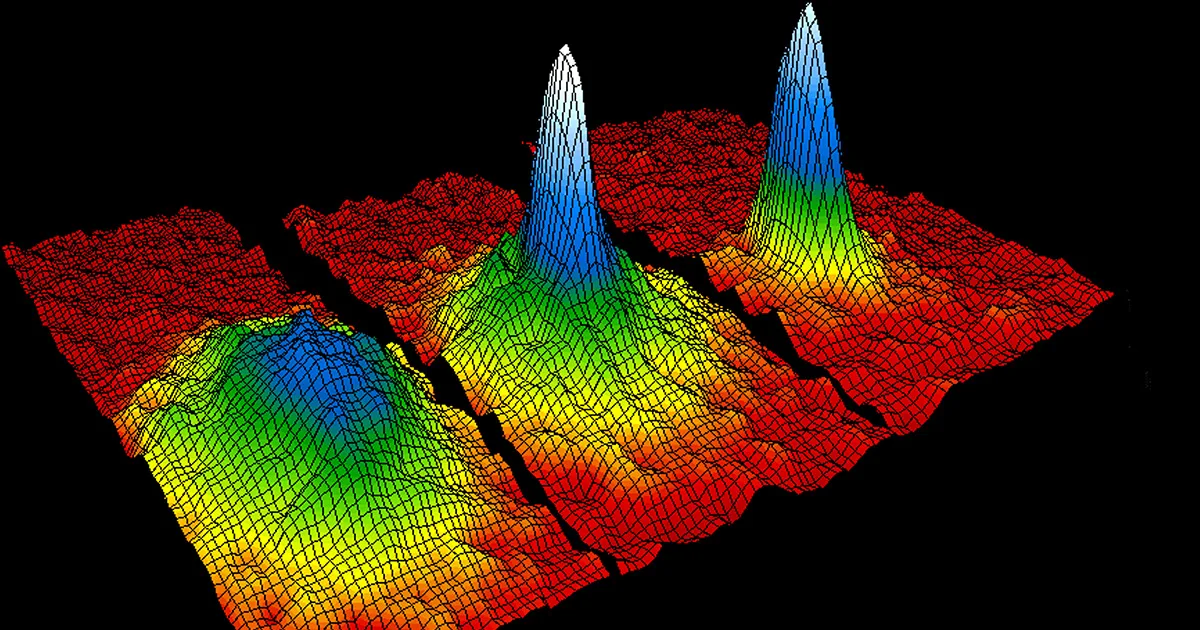
In most cases, the de Broglie wavelengths of gas are much smaller than the distance between particles, and we can describe the gas using classical physics. But if we cool the gas a lot, down to near absolute zero, the thermal de Broglie wavelengths of neighbouring particles start to overlap, and we need quantum mechanics to describe what’s going on.
The whole picture came together when Satyendra Bose sent Einstein his derivation of the black body radiation law by treating photons as indistinguishable particles. Einstein saw the significance of this immediately, and applied it to ideal gases. In his second paper about this, he realised that after a certain amount of cooling, there would be a mysterious “condensation” from a boson gas. Since the Pauli Exclusion Principle doesn’t apply to bosons, when their thermal de Broglie wavelengths become longer than the separation between them, they condense into the same quantum state. They begin to behave as one.
 1SStarTalk by Neil deGrasse Tyson
 5OObservations on Quantum Computing & Physics · Jan 1, 1970By A. Einstein